Originally published in Verbicide issue #12
In a little Washington town located in the farthest northwestern tip of the United States, you will find Dave Crider, Estrus Records founder and eponymous garage-rock guitar grand poobah. Bellingham is closer to Surrey than Seattle, but the Estrus label — occasionally lumped into discussions concerning the “g-word” explosion of the early ‘90s — has been around since long before the hype and has continued to put out quality slabs for many years in the aftermath.
Estrus has survived for so long thanks largely due to the fact that Crider has a knack for scooping up the cream of the crop in the glut of guitar-driven hard rock spawned in the music underground. His label has subsisted on his good judgment in choosing bands simply because he likes their music and he likes them as people — which has, in turn, resulted in hundreds of seven-inches and full lengths, many falling into the “must-have” category.
Related Posts
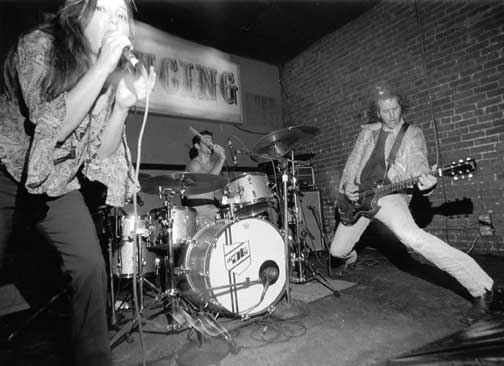
Included in this category? Dave’s own bands, including Watts, who popped up for a brief time in the late ‘90s, and, of course, the Mono Men. In the wake of those bands, Dave is now grinding on the guitar in The Dt’s, self-described as “hard soul” and described by any listener to be unlike anything they’ve heard before coming out of the Pacific Northwest. Included on The Dt’s roster are vocalist Diana Young-Blanchard (formerly of Madame X) and drummer Phil Carter. After a conversation with Dave about the history of Estrus Records and the nuances of the day-to-day operations, Diana and Phil joined us for a discussion about the new band.
Well, Dave, I’m probably going to bore the hell out of you with my Estrus-related questions, because I’m sure it’s stuff you’ve been asked a million times over the past 15 years or so, but…
Dave Crider: Well that’s alright! It’s actually almost 20.
Almost 20? Holy crap. I thought you started in 1991.
Dave: 1987, actually. Maybe 1985, when the first cassette came out.
What was the first Estrus release?
Dave: You know, it’s a little foggy, but those 1985 to 1987 years are when it was first going on. The first seven-inch release actually did not come out until 1989.
And that was The Mono Men.
Dave: Yeah, that was the Mono Men thing, and there was a cassette we did in 1987. Yeah, so it was ’87.
But 1985 was when the concept of the label came about?
Dave: I’m a little foggy on that, to tell you the truth, so I’m gonna go with ‘87!
It’s okay, I was in kindergarten in 1985, so that time’s a bit foggy for me, too.
Dave: All right, right on! (laughs)
Related Posts
When you started the label, was it simply a method of getting your own music out there, or was it something that you thought of, at the time, as a potential long-term endeavor?
Dave: Oh, no. We wanted, originally, just to do this cassette release for the band at the time, which was The Roof Dogs, and we needed a name to slap on that, so it was Estrus. And then, when it came time to do the Mono Men single…we had offers from other labels to release it—
Such as?
Dave: Get Hip was actually pretty hot on doing something with us. But we just decided, after looking at it, “well, it’s not that hard to do, we’ll just do it ourselves.” So that’s what we did. And then after that, we kind of looked around, figured out it wasn’t that hard to do, and saw that there were other bands that needed help [releasing albums], so we just went from there. We never meant to become anything than just a way to release our band’s and our friends’ [records]. And it sort of steam-rolled from there. It’s a glorified hobby gone awry!
It’s a fulltime hobby!
Dave: Oh, it’s more than fulltime…
What does “Estrus” mean anyway?
Dave: (laughs) Well, I was an anthro/bio major. I dropped out of college with less than 10 credits to go because I got offered a job at the “cool record store” — so I had my priorities straight, didn’t I? But, anyway, Estrus is…well, you should just look it up in the dictionary, because it applies to that! I just figured I’d use my education for something, so I just threw it on there!
At what point did you realize that you were onto something with the label, and that it would continue to be a viable force in the underground music scene for such a long time?
Dave: Uhhhh….never! (laughs) Really, I would like to say that there was that dawning, but it was more just that the thing steamrolled, and I tried to keep up with it.
So there never really was some epiphany where you just woke up and said, “Hey, look at this, I’m making it!” It’s just been a day-to-day operation for two decades?
Dave: Still, I’m not even sure I could say that now! With a small, independent label you’re always sort of struggling. I do think that the label has built a strong foundation over the years, for sure. But, I’m always so busy, I don’t really think about it in those terms. It’s just become a pretty big part of what I do and who I am.
How many albums have you released?
Dave: As far as full-lengths go, I think 106 or 107…as far as singles go, I think probably a couple hundred. It’s a pretty big discography; there’ve been a few box sets and CD-only releases that don’t quite fit into that number. I suppose I should sit down and figure out exactly what it is; that would be an interesting number to be able to just throw out. But it’s been a lot.
Related Posts
To date, what’ve been your most successful bands and releases?
Dave: Well, you know, this is a question that I have mixed feelings about how I want to answer it, because I never think of any release in terms of whether it’s successful or not in a commercial sense. So, in that way, I feel that they’re all successful. I mean, obviously, there are bands on the label that have achieved a little bit more presence in the mainstream — like Man or Astroman?, Mono Men, The Makers, The Mummies…more recently, Soledad Brothers, Mooney Suzuki, or the Immortal Lee County Killers. But do I look at those bands as being more of a success? Well, maybe commercially, yes, but artistically? No more so than any of the other releases. How’s that for a non-answer?
No, actually, that’s pretty good; it’s kind of what I expected you to say — actually, it’s kind of what I would hope you’d say. If you’re running an independent record label, you should feel that way about all your releases. If you’re an artist for art’s sake, than you appreciate everything on that level.
Dave: Right, exactly.
I was kind of wondering about the commercial success, too, though…
Dave: Sure, well, like I said, I don’t generally think of things in those terms. When I make a decision as to whether I’m going to work with a band, it’s really not at all based on whether they’re going to be commercially viable or not — it’s whether I respect what they’re doing musically and if I like them as people. And there’s an inspiration that comes from that, and for me, that’s the greatest part of doing it. I think it’s probably going to be the same for several of the other people you talk to. I don’t have to think in [commercial] terms — so I don’t. It’s not what motivates me to do this.
And if you’re in that situation where you can think like that, it’s a testament to your own good judgment over the years to get you to that point.
Dave: I guess so, yeah!
Here’s a question I’m almost embarrassed to ask…and I was hoping to get a good angle on it…I used to own the video Hype! [a documentary on the Seattle music explosion in the early ‘90s], but I lost it—
Dave: I don’t even own it!
Well, I remember the first time I ever heard or read an interview with you was on that documentary, so I wanted to reference it in this interview, but I can’t find a copy anywhere. So, I’m just going to ask you the broad question: what was it like to be in the midst of the Seattle thing in the early ‘90s?
Dave: Well, I think the thing you’ve gotta remember — and I believe we touched on this in the interview in Hype! — is that Bellingham is almost 90 miles north of Seattle. Okay, that’s pretty close, but if you look at a map of Europe, that’s almost a country away. So, as a general rule, I don’ think that Bellingham was considered a part of that [scene]. And what we were doing up here was sort of different. I know that both the label and my band, the Mono Men, did gain benefit from [Seattle], without a doubt. But we were still more of the “hillbillies.” I don’t know how else to put it. We were never right in that scene; we didn’t play too many shows with too many of those other bands.
I’ve definitely worked with bands [from that area] over the years on, like, compilations…and I’m not saying this in arrogance or in a belittling sort of way…it’s just, I never really thought of the Mono Men, or Estrus, or any of the bands as being part of that. Even though I know we’re geographically close, we never felt part of it. We weren’t trying not to be, it’s just that, we’re in Bellingham and we’re gonna do what we’re gonna do.
You mentioned 90 miles taking you from one country to another in Europe, well, I come from New England where the scale of relative size for states is pretty small, and 90 miles from Boston will get you out into the woods of New Hampshire or Vermont. I don’t think there’s anything happening in Boston that anyone in southern New Hampshire takes credit for.
Dave: Yeah, that’s the thing, and that’s where I give Doug [Pray, director] a lot of credit when he made that film. He looked outside, he looked at areas as far out as Portland and Olympia. When he contacted [the Mono Men] about [being in the film], I was pretty adamant that, if we’re gonna do this, we’re not gonna drive down to Seattle and play a Seattle club — we’re going to play Bellingham, because that’s where we’re from. And it was pretty expensive for him to do that — he brought the mobile truck up here, and he actually shot Gravel as well, but they didn’t end up making it into the film, which is unfortunate, because they did a great set that night. He was totally cool about trying to represent the Northwest as a whole. He covered the peripherals pretty well. There were some bands he missed, but how are you not going to? There was so much music going on; there still is. So…that has always been my take on it; Seattle’s just that city down south.
Ha! Nice. The “deep south” of the Pacific Northwest.
Dave: Yeah, we call them “mid-sounders.” We’re “north-sounders” here.
Are you from Bellingham?
Dave: No, actually, I moved here to go to school and I just never left. I moved all over the place when I was younger. I was born right outside of Baltimore, and then pretty early on my folks moved to the UK. Then I lived in the UK until right around 1970. Then I moved back to the Annapolis area and lived there until ’76 when I moved to Yakima, which is where I met Diana [Young-Blanchard, the Dt’s vocalist]. We went to school together. Then I moved up here to go to college, and just never left. There’s actually an Indian curse on this town, that once you move here, you never leave — and I’ve seen it an awful lot! (laughs) I don’t know if it necessarily applies, but it’s a nice place to live and that’s why I’m here.
Well, I guess if you want to grab the rest of the guys, I have a few Dt’s-related questions prepared.
(Diana and Phil join the conversation and introduce themselves)
I’m sure you’ve been asked this a lot, but how did you guys end up coming together to create a band that’s such a departure in style from Watts, Madame X, or Mono Men?
Phil Carter: Well, I guess Dave and Diana wanted to play in a band together, so they started it, and quickly realized they needed someone to play drums—originally it was going to be Aaron Roeder from the Mono Men — but he never showed up to any of the practices. (laughter)
Diana Young-Blanchard: Well, he showed up for one.
Phil: Okay, he showed up for one, but I stumbled on and that was that.
Diana: Phil was actually supposed to play bass for us originally, but we didn’t have a drummer. So we decided, “Well, we need a drummer more than we need a bass player,” and we ended up not having a bass player.
As far as the style of the music is concerned, are their certain aspects of the music that you’ve created as the Dt’s that fulfill creative elements you were lacking in your past bands? Or is this something that is so completely different it doesn’t warrant much comparison to your past work?
Phil: It’s very much unlike anything I’ve ever done.
Dave: Yeah, I wouldn’t say it’s anything that I myself am doing because I felt like it was lacking in what I was doing before, it’s just sort of a progression. I’ve wanted to do something like this — with Diana in particular. I mean, I tend to think of projects [in terms of] the people I want to work with. And that’s always going to make things different, because people are different. I think what I’m playing now is a logical progression for me, because a lot of what I was doing guitar-wise and songwriting-wise in Watts was sort of a push in this direction. I don’t know that it came through [in Watts], because those other guys would laugh at me when I’d say, “Okay, here’s my Motown song.” I’m not so sure you can hear that, but that’s what was going on there.
Phil: You can’t hear that. (laughter)
Dave: But with the Dt’s…I think it’s a pretty good indication of what each person in this band brings to it.
Diana: [In comparing the Dt’s to Madame X or Watts] I think it shows what range we have, in our abilities and in our musical tastes.
You actually mentioned this earlier, but I read in your band bio on your website that the Dt’s were formed after, quote, “long musings” about how you two, Dave and Diana, “were going to get a band started ‘one of these days.’” How long exactly has this musical collaboration been in the making?
Dave: Conservatively, I’d say 10 years.
That’s conservative?
Diana: Yeah, we’ve known each other since high school, and music was something that we’ve always connected with. We did attempt to have a couple of bands, but we couldn’t really find anyone else — we were in Yakima for Christ’s sake, we couldn’t find people to play with, places to play…
Dave: Didn’t know what to do…
Diana: And then we lived in different towns for all this time, until three years ago. And one of my main reasons for moving up here was so that we could do this. Because it’s been talked about for so long.
How has the reaction been to the new album [Hard Fixed]? Have you guys gotten lots of feedback from longtime fans of your past work?
Dave: Overall, it’s been pretty good, but you don’t necessarily hear the shit — not directly anyway.
That’s what fanzines are for. (laughter)
Dave: I think the only negative stuff we hear about are from people who haven’t really given it a chance, and don’t listen to it, and just discount it with whatever label they want to use without really giving the music a shot. That’s so fucking common it makes me sick, but that’s just the way it is. People tend to want to just trivialize stuff sometimes. But I can’t say that I’ve had anyone who’s been a big fan of a past band come up and say either, “this sucks balls,” or “this makes me want to lick your balls.” (laughs)
Diana: We just kind of expect that, actually, we expected more of that—
Dave: I generally expect my balls to be licked all the time. (laughter)
Diana: Yeah, right. We don’t expect a ball-licking, okay?
Phil: I was hoping for that!
Diana: Anyway, when we went out on the road a couple of times, and we were hitting old Mono Men territory, we kind of expected there to be more people saying, “This doesn’t sound anything like the Mono Men!” Well, yeah, duh! It’s not supposed to. But we thought we’d encounter more of that criticism…We did get some funny pettiness — which really pissed me off at the time, I’ve gotten over it — from some guy to came to see us in Missoula. He was an “Estrus man,” big Mono Men fan, who wrote something like, “Just because you’ve got some bitch in your band you went to high school with doesn’t make you a soul band! (laughter) But that little bit of pettiness that we’ve experienced, publicly, that people have written, seems to be based on that people think we’re trying to be something we’re not — and they say, “Well, they’re a good band, but they’re not a soul band!” I mean, we’re not Smokey Robinson and the Miracles, but I don’t think those [critics] understand soul, and a soul-feel.
When you guys take off on tour, who takes care of the day-to-day label work?
Dave: I do…the wonders of modern technology!
The wonders of the invention of the cell phone and the Internet.
Dave: Exactly! I have a little wireless Internet thing, and I have Bekki and Carl here, so they take care of things that need to happen here — but for the most part, it’s unbelievable how seamless that shit is now. It’s boggles my mind.
What are your upcoming plans?
Dave: Well, we are working on our new album. We have a tour of Spain brewing, which is looking good, and also Argentina and Brazil — which hopefully will happen. There was a plan, originally, to go out and hit the East coast in August, but we decided to take August a little bit easier and stick to the Northwest. But I love going out on the road, it’s one of my favorite things.