Deprived of my camera for a night, I am left in a unique position: getting to sit back, relax, and enjoy a show. Usually without my camera to keep me occupied I am fidgety, frustrated for every moment I witness that is not captured. Tonight, however, I am more than eager to enjoy Björk’s Biophilia.
Upon entering, we learn why I am sans lens for the night, with notices posted everywhere that state:
Related Posts
“At the request of the artist, absolutely no photography or filming is allowed during tonight’s performance. Cell phone cameras are included.”
While this saddens me as a photographer, it makes me ecstatic as a live music fan. We have long passed the point of acceptability in terms of cell phone photographers spending the whole night staring at shitty images on the back of their phones, while the people behind them crane their necks to enjoy the show. Kudos to Björk, and all artists that are taking a stand, concertgoers will thank you…eventually.
Björk’s Biophilia was made to be witnessed firsthand. Every moment is choreographed to combine sound and sight with feelings and experience. If I had a camera, though, this is what I would point it at.
The Crowd
I arrive early. The website says 7 p.m., and the last time I made too many assumptions about shows in Hollywood I missed the first three songs. I see a long line forming as I walk up, so decide to grab a coffee to keep me company as I make my way to the back of the line. The line stretches around the block so I have an opportunity to check out the crowd as I take the five-minute walk to the end.
Hollywood is known for its eclectic mix of people, so I am not surprised that the crowd follows the same formula, though I was expecting more weirdness. I pass plenty of dreadlocks, fishnets, forehead jewels, platform boots, and one girl with a free burrito. This mix speaks to the appeal of Björk and her long career — fans truly come from all age brackets and all walks of life, joining together for an amazing night with Biophilia.
The Stage
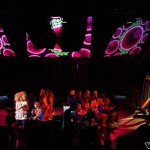
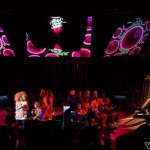
The stage is set in the middle of the floor, where on a normal night at the Palladium the standing room crowd would be. The stage is set as two rectangles, a small rectangle on top of a larger rectangle, which allows Björk and the choir to move between levels. On each side of the stage is a section of the crowd, two standing room only areas and 2 seated areas. The effect is unique as each portion of the crowd spends 75% of the time staring at Björk ‘s back, though she never stands still long enough for it to get frustrating, and portions of her choir are visible the entire time.
In each corner of the stage is a set of instruments. One corner contains drums and a variety of other percussion instruments I have never seen before. Another corner contains keyboards, laptops, and lots of flashing lights. The third corner is where the harpist keeps her harps and harp-like instruments. The last corner contains a large, homemade contraption with four pendulums that is used during the song “Solstice” and should probably be Googled, since I have no idea how it works. In addition, a Tesla coil is lowered from the ceiling and is used as an instrument on the songs “Thunderbolt,” and “Possibly Maybe.” The unique assortment of instruments bring to life the real Biophilia experience.
The Choir
The Biophilia show includes an 18-piece all-female Icelandic choir dressed in sparkling blue and gold robes that shimmer when hit by one of the four spotlights. The girls are all beautiful, lively, and buoyant, adding angelic depth to the music, while matching Björk’s sometimes frantic energy. They move between songs, sometimes creating small groups facing each other, and other times circling the stage and facing the audience. This movement is choreographed chaos as no two girls or groups dances the same, but there is rhythm to the randomness and the effect is as pleasant as their collective voice.
Björk & Biophilia
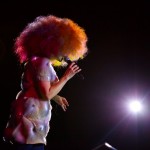
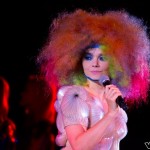
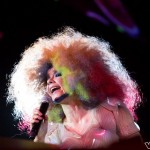
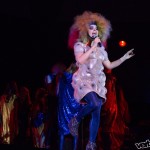
A man’s voice over the speakers introduces Biophilia as the convergence of nature and music and technology and goes on to introduce the first song, “Thunderbolt,” with its fuzzy Tesla coil-led electronic backbone. The light comes up on the stage to reveal the choir and Björk, in a multicolored cotton candy wig, white face paint with large rings of blue eye shadow, and a blue strip of makeup circling her face and under her chin. Björk’s dress addresses the technological side of Biophilia as it appears to be covered in a number of clear balloons, each of which reflects and refracts the stage light, giving her the appearance of being surrounded by sparkling energy.
Björk comes across just as I expected, quirky and precious. She tiptoes around the stage, smiling sweetly to her backing singers, but not interacting much with the crowd. Between songs she squeaks, “Thank you!” or “Gracias,” before quickly moving onto the next song. This simple moment of interaction, especially after her first song, elicits a strong cheer from the crowd. People adore Björk, and feel the Biophilia experience deeply.
Biophilia lasts for more than an hour and a half, touching on each area of the Biophilia at-home experience. The ring of screens above the stage plays animations coinciding with the songs core themes. “Virus” shows an atomic view of dancing and pulsating cells being attacked by a virus, while the single “Crystalline” shows growing and morphing crystals.
In the 19-song set, a number of old favorites are interspersed. These songs do not maintain the thematic elements of the night, but stand up as quality songs from a long and successful musical career. The final three songs, performed as an encore, create a perfect end to the night, led by “Possibly Maybe.” The popular Volta song, “Declare Independence” is the final song of the night, with 22 performers and hundreds of people all yelling, “Declare independence, don’t let them do that to you,” as Björk and company stream from the stage, leaving behind a sea of delighted fans, tears even glistening in some eyes as we make our way back into the warm Hollywood night, together.